
Shaniwar Wada, Pune — a visitor's guide
Historic seat of the Maratha Peshwas
Shaniwar Wada was the seat of the Maratha Peshwas, and its surviving walls still mark a centre of old Pune. Built in 1732 by Peshwa Baji Rao I, the fortified palace served as an administrative headquarters until British control in 1818. A fire in 1828 destroyed much of its timber-built interior. What you visit now is largely an open historic enclosure, with gateways, foundations and traces of the palace rather than furnished royal rooms.
For someone planning a stop at Shaniwar Wada, Pune offers an old-city setting that is as much a part of the visit as the monument. People come for Maratha history, photographs of the formidable entrance and a walk through the grounds. It works well as a relatively short sightseeing stop, particularly if you leave time for the streets and markets nearby.
What you will find inside
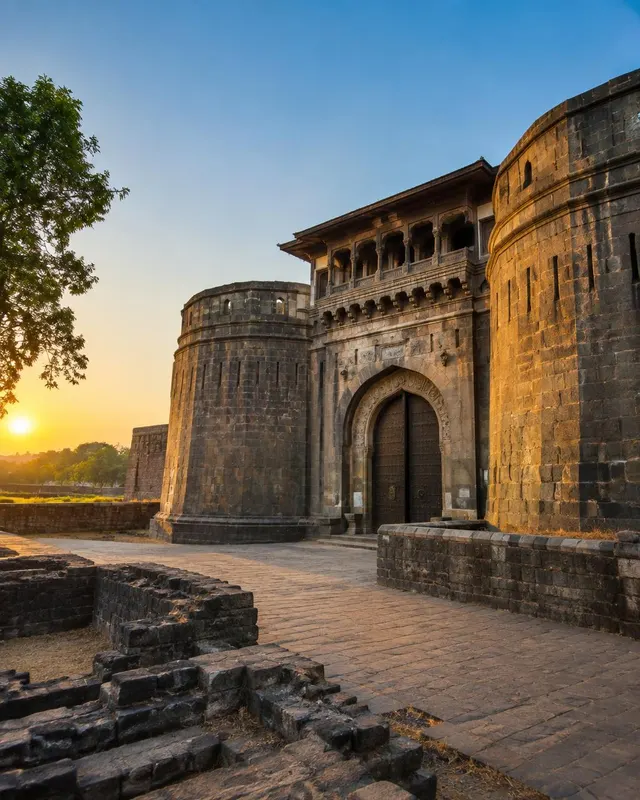
The Dilli Darwaza is the most striking surviving feature. Its heavy doors carry iron spikes, a defensive measure against charging elephants. Pause here before entering: the scale of the gateway gives a stronger sense of the palace’s original authority than the low remains inside.
Beyond it, gardens and exposed foundations occupy space once filled by halls and residential quarters. The loss of the wooden buildings matters to expectations. This is not a palace visit built around decorated chambers or collections of objects. Its interest lies in reading the layout, looking at surviving masonry and imagining how a much larger household and administration occupied the enclosure.
The remains of Hazari Karanje, the palace fountain, are another feature to look for. Access to wall sections and elevated viewpoints can change, so follow the barriers and directions in place rather than assuming every staircase is open. Stone steps can be uneven, and some areas offer little shade.
Allow roughly an hour for an unhurried look, longer if you enjoy architectural details. Comfortable shoes are useful both inside and on the surrounding streets. Anyone with limited mobility should check current access arrangements before relying on step-free movement throughout the site.
Arriving in the old city
Shaniwar Wada stands beside the densely built peth neighbourhoods, the historic quarters that give central Pune much of its character. Around the monument, traffic, small businesses and everyday errands continue alongside sightseeing. This is a working city centre, not a quiet heritage precinct.
Auto-rickshaws and app-based cabs are convenient ways to reach the area. Ask for the main visitor entrance, since a drop-off beside another stretch of the perimeter can leave you walking around the block. Approaches can be slow during office travel periods and busy shopping hours. If arriving by car, check parking arrangements beforehand; nearby roads are not a good place to assume you will find an empty space.
Pune Junction is the main railway arrival point for many visitors, with a road journey needed to reach the monument. Pune Metro is another option. Kasba Peth, also identified as Budhwar Peth on some maps, and PMC are useful stations to check against your starting point and the current network map. The final stretch is on foot or by auto, depending on your route.
Walking is often the simplest way to connect nearby sights, but pavements can narrow or be interrupted by parked vehicles. Cross at a controlled junction where possible, especially around the busier approaches.
Choosing your time and nearby stops
October to February generally brings the most comfortable conditions for exploring the grounds. Earlier in the visiting day is usually preferable if you want gentler temperatures and time for other old-city stops afterwards. Check current entry hours before setting out.
Summer afternoons can be tiring in the open enclosure. Carry drinking water and sun protection. The monsoon makes the gardens greener, though rain can interrupt walking plans and leave stone surfaces slippery. Later visits may suit photographs in softer light, but leave enough time before the day’s last admission.
Among the places to visit near Shaniwar Wada, Lal Mahal is a natural companion stop because of its association with Shivaji Maharaj’s early life. The present building is a reconstruction, a distinction worth keeping in mind. Dagdusheth Halwai Ganpati Temple is also nearby and draws worshippers as well as visitors.
For a longer outing, Raja Dinkar Kelkar Museum adds a different perspective through historic objects and decorative arts. Avoid squeezing every stop into one rigid schedule. Temple queues, traffic and the temptation to browse a market can change the pace. During Ganeshotsav, the central streets become especially busy, and diversions can affect access.
Eating and shopping around the monument
There are plenty of restaurants near Shaniwar Wada in the surrounding central neighbourhoods, though the immediate streets are better suited to informal eating than a quiet, drawn-out meal. Maharashtrian snacks are an obvious choice: look for poha at breakfast or misal pav if you want something more substantial. Misal can be fiery, so ask about the spice level before ordering.
Peth-area eateries include vegetarian meal places, snack counters and sweet shops. For somewhere to sit, check seating before ordering; a busy takeaway counter may have little room indoors. Opening patterns differ, and some smaller establishments pause between meal periods.
Tulshibaug is a useful nearby shopping stop for household goods, accessories and everyday purchases. Laxmi Road is better known for clothing, including sarees and occasion wear. Both can become crowded, particularly during festival and wedding shopping periods. Mahatma Phule Mandai adds the bustle of a produce market rather than souvenir shopping. Keep purchases manageable if you still have the monument or a museum ahead of you.
Staying nearby and sorting out daily needs
If you are comparing hotels near Shaniwar Wada, central Pune locations make sense for a history-and-market itinerary. Deccan Gymkhana and Shivajinagar offer other practical bases, while the Pune railway station area suits travellers prioritising train connections. Check the actual route rather than distance alone: traffic and one-way streets can make a short trip less direct.
For rooms in older commercial neighbourhoods, ask about lift access, vehicle drop-off and street noise. These details can matter more than being a few minutes closer to the entrance.
The surrounding shopping streets generally have pharmacies and medical shops, along with provision stores selling bottled water, toiletries and packaged snacks. Do not assume every pharmacy stays open late or stocks a particular prescription. Carry regular medicines in their original packaging and keep the prescription accessible if you may need a refill. Buy water before entering the grounds rather than relying on an outlet inside.