
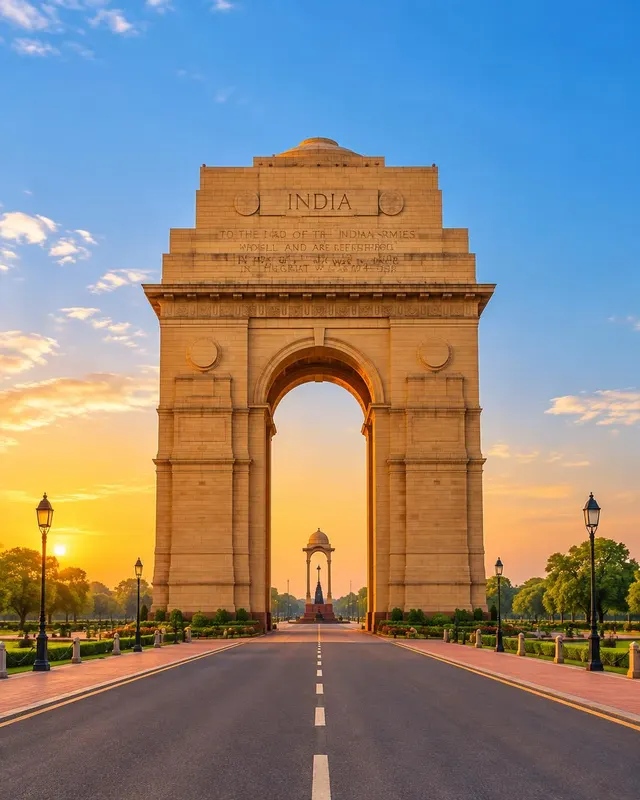
India Gate, Delhi — a visitor's guide
A war memorial along the Kartavya Path
India Gate stands at the eastern end of Kartavya Path, where central Delhi opens into broad lawns, long sightlines and unusually generous stretches of sky. The sandstone arch is a war memorial, but the grounds are also a place for an evening walk, a family outing or a pause between other Delhi sights. People come for the monument and often spend longer walking around it than they expected.
Edwin Lutyens designed the 42-metre arch, which opened in 1931 to commemorate soldiers of the British Indian Army who died in the First World War and the Third Anglo-Afghan War. Thousands of servicemen’s names are inscribed on its surface. Seen close up, those names give the monument a different weight from the familiar distant view across the lawns.
The memorial and the grounds around it
Behind the arch lies the National War Memorial, inaugurated in 2019 to honour members of India’s armed forces who died in service after independence. Its eternal flame and concentric layout make it a distinct visit, rather than simply an extension of the India Gate lawns. Leave time for both. Access arrangements for the memorial can differ from those around the arch, particularly during official events.
Kartavya Path stretches west towards Vijay Chowk and Rashtrapati Bhavan. The area belongs to New Delhi’s planned ceremonial centre, with government buildings, mature trees and broad roads rather than a close-packed market neighbourhood. Distances can be deceptive here: something that looks nearby across an open vista may still require a substantial walk.
Around sunset, the atmosphere becomes more social. Families gather on the lawns, walkers follow the paths and visitors stop for photographs as the arch is illuminated after dark. Snack sellers may be present in permitted areas, though their locations and availability can change. Closer to the memorial spaces, a quieter manner is appropriate.
Getting there and choosing your time
For an India Gate, Delhi outing, the Metro is often more predictable than driving through central traffic. Central Secretariat and Khan Market are useful stations to consider, though neither leaves you directly beside the arch. The better choice depends on your starting point and which side you intend to approach. Check the walking route rather than relying only on the straight-line distance shown on a map.
An auto-rickshaw or cab can cover the last stretch, subject to current traffic restrictions. Drivers may have to leave passengers at a permitted drop-off point away from the monument. Agree on a recognisable pickup location for the return trip; “at India Gate” is too vague across such a large area.
Parking and road access can change during ceremonial occasions, especially around Republic Day preparations and celebrations. Barriers may also alter pedestrian routes. If travelling with someone who cannot walk far, confirm the current approach before leaving and allow extra time between the drop-off point and the grounds.
October through March generally brings the most comfortable walking weather. Early morning suits visitors who prefer a less crowded setting, while late afternoon gives you daylight for seeing the stonework followed by the illuminated evening view. Winter mornings can be foggy, and Delhi’s air pollution may make a long outdoor visit unsuitable on some days.
Summer afternoons are very hot on exposed paths. Carry water and favour an early or late visit. Monsoon showers can interrupt a walk, with lawns becoming wet even when the paved routes remain usable. Comfortable shoes matter more here than a tightly packed sightseeing schedule.
Food and places to explore nearby
The immediate grounds are not a restaurant district. Small snacks or ice cream may be available around authorised vending areas, but a sit-down meal usually means leaving the lawns. Carry drinking water rather than assuming a seller will be close to wherever you stop.
For restaurants near India Gate, Pandara Road is a practical area to look at, particularly for North Indian meals. It is associated with established dining spots serving dishes such as kebabs, dal and paneer preparations. Khan Market has cafés and restaurants alongside its shops, making it useful for a meal combined with browsing. Connaught Place offers more choice if it fits your onward route.
These areas are nearby in central Delhi terms, not necessarily an appealing walk in midday heat. A short cab or auto ride may be sensible after time on the grounds. Restaurant opening hours and waiting times vary, so check your chosen venue separately rather than assuming it will suit an early breakfast or a late dinner.
Among places to visit near India Gate, the National War Memorial is the easiest to pair with the arch. A walk along part of Kartavya Path gives a better sense of the ceremonial avenue without requiring you to cover its entire length. Farther afield, Purana Qila and the National Crafts Museum are reasonable additions to a central Delhi day, but each deserves its own time allowance and transport plan.
Staying, shopping and everyday essentials
Visitors looking for hotels near India Gate generally stay in surrounding central Delhi districts rather than immediately beside the monument. Connaught Place and Janpath are convenient for travellers who want Metro connections, restaurants and shops close to their accommodation. The Mansingh Road area has luxury hotels nearer the ceremonial centre. Compare the actual entrance-to-entrance route, since a central address does not always mean an easy walk.
For shopping, Khan Market is useful for books, clothing and groceries. Janpath is better known for souvenir browsing and stalls selling clothing, accessories and handicraft-style goods. Connaught Place combines larger retail outlets with places to eat. There is no substantial shopping street directly around the India Gate lawns.
Pharmacies and medical shops are easier to find in commercial areas such as Khan Market or Connaught Place than beside the memorial. Anyone carrying regular medication should bring enough for the outing, particularly if planning to stay through the evening. Check the nearest open pharmacy on a current map if something is needed urgently.
For bottled water, toiletries or other daily supplies, use the shops around your hotel or a neighbourhood market before arriving. The ceremonial precinct has fewer everyday shops than its size might suggest. A refillable water bottle, sun protection and a light layer for a winter evening are useful things to have in your bag.