
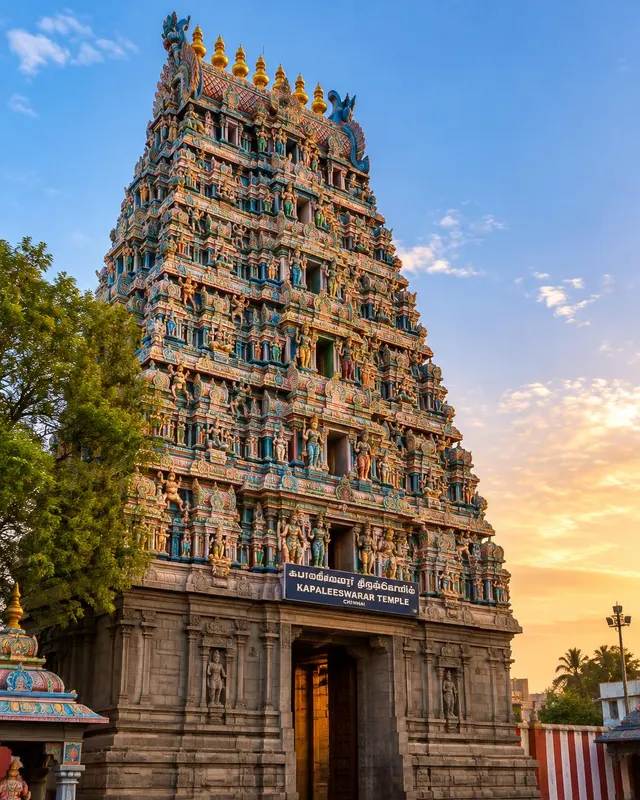
Kapaleeshwarar Temple, Chennai — a visitor's guide
Active seventh-century Shiva temple in Mylapore.
Kapaleeshwarar Temple in Chennai is a working Shiva temple whose daily worship shapes the streets around it. People come to pray to Kapaleeshwarar and Karpagambal, admire the sculptured gateway, or spend a morning in Mylapore, one of the city’s oldest neighbourhoods. Flower sellers and shops selling puja articles stand close to the entrances. Beyond them, ordinary neighbourhood life continues around the temple tank and along the surrounding Mada Streets.
The temple’s origins are associated with the seventh-century Pallavas, while the present complex is generally linked to rebuilding during the Vijayanagara period in the sixteenth century. That distinction matters: this is a centuries-old religious tradition, but the buildings should not all be read as seventh-century remains.
Inside the temple and around the tank
The eastern gopuram is the most conspicuous landmark, covered in painted figures drawn from Hindu mythology. At street level, its scale is especially striking against the surrounding shops. Inside, stone-pillared mandapams and separate shrines reward a slower visit, though worshippers moving towards a shrine should always have room to pass.
One of the temple’s best-known traditions concerns Parvati worshipping Shiva in the form of a peahen beneath a sacred Punnai tree. The tree shrine gives that story a physical setting within the complex. The peacock association also runs through the traditional explanation of Mylapore’s name.
The large tank lies along the western side of the temple. It is associated with the float festival and gives the neighbourhood a more open aspect than the narrower shopping streets. Water levels and access conditions can vary, so treat it as part of the temple setting rather than somewhere you can necessarily walk down into.
Dress modestly, remove footwear before entering, and check the rules before taking photographs. Access to the inner sanctum is restricted, including for non-Hindu visitors. Follow signs and instructions at individual shrines rather than assuming that access to the courtyard extends everywhere. A bag for footwear can be useful, though you should follow the arrangements in place at the entrance.
Getting there and choosing your time
Mylapore is well connected to the rest of Chennai, but the final approach is through busy local streets. Thirumayilai MRTS station is a useful rail access point within walking distance of the temple area. City buses serve Mylapore, with Luz being a familiar nearby reference point. Check current services before travelling, particularly if your route depends on a rail connection.
An auto-rickshaw or app-based cab is straightforward for visitors unfamiliar with Chennai. Give the temple name and Mylapore as the destination, then agree on a recognisable pickup point for the return trip. The closest entrance is not always the easiest place for a driver to stop. During festivals, traffic restrictions may mean walking the last stretch. Parking immediately around the temple can also be difficult.
Early morning generally gives you the most comfortable conditions for walking barefoot through the courtyards. Evening has a different appeal, with lamps, worship and busy shopping streets, but it is not necessarily quieter. The temple usually follows separate morning and evening sessions with a midday closure; confirm current access before planning an afternoon arrival.
The cooler months, roughly November through February, are preferable to Chennai’s hotter summer weather. Rain can still interrupt plans, especially during the northeast monsoon towards the end of the year. Carry drinking water and avoid leaving a long outdoor walk for midday.
Panguni Peruvizha, usually in March or April, brings processions and much heavier foot traffic. The Arubathimoovar procession is particularly associated with Mylapore’s festival calendar. Come then for the religious celebrations, not for an unhurried architectural visit, and allow extra time to leave the neighbourhood.
Eating and exploring Mylapore
Breakfast fits naturally around an early visit. Mylapore is known for vegetarian tiffin restaurants serving idli, dosa, pongal and filter coffee. Established names associated with the neighbourhood include Rayar’s Mess and the long-running Karpagambal Mess. Check their current service hours rather than assuming every place serves throughout the day.
If you are comparing restaurants near Kapaleeshwarar Temple, distinguish a small, quick-service tiffin room from somewhere suitable for a longer seated meal. Some older establishments have limited seating and queues at popular breakfast hours. For lunch, vegetarian meals are a practical choice in the temple neighbourhood. Visitors needing more dining options can look along the larger roads towards Luz, Alwarpet and Radhakrishnan Salai.
Several places to visit near Kapaleeshwarar Temple fit into the same outing without requiring a cross-city journey. San Thome Basilica, towards the coast, offers a different religious and architectural setting. Ramakrishna Math in Mylapore is another nearby stop, with its own visiting arrangements and expectations of quiet.
The seafront can follow later in the day. Marina Beach is better treated as a separate leg by auto or cab if heat or tiredness is an issue. Do not judge walking effort by distance alone: road crossings, humidity and busy pavements make a difference here.
Staying nearby and handling everyday needs
Visitors usually look beyond the immediate temple streets for accommodation. Mylapore, Alwarpet and the Radhakrishnan Salai area are practical bases for combining the temple with other central and southern Chennai stops. Royapettah is another option. When comparing hotels near Kapaleeshwarar Temple, check the actual road location, vehicle access and recent information about noise. A short map distance does not guarantee an easy walk.
The Mada Streets are useful for religious shopping, including flowers, brass lamps and puja supplies. Silk and traditional clothing shops are also part of Mylapore’s retail character. For more extensive clothing shopping, Luz is a nearby option; T. Nagar requires a separate trip and more time. Ask before photographing shop displays or people making garlands.
Pharmacies and medical shops are generally easier to find along Mylapore’s larger commercial roads and around Luz than within the busiest temple approaches. Bring regular medication with you, and carry the prescription if you may need a refill. Do not assume every shop stays open late or stocks a particular brand.
Small provision stores and grocery shops around the residential-commercial streets cover bottled water, toiletries and simple snacks. Buy water before joining a festival crowd. For a return cab, carry a charged phone and save a pickup landmark on a wider road rather than relying on the congested space beside a temple entrance.